
Is it cheaper to buy Mikimoto pearls in Japan? A Complete Price Guide
For luxury pearl shoppers, Is it cheaper to buy Mikimoto pearls in Japan? This guide covers price comparisons, tax refunds, duty-free perks, and tips to maximize savings on your purchase.
For luxury jewelry shoppers, Is it cheaper to buy Mikimoto pearls in Japan is a common and practical question.
Mikimoto, the iconic Japanese pearl brand, is synonymous with unparalleled quality, but its premium price tags leave many wondering if buying in its home country offers meaningful savings. Many assume that because Mikimoto is Japanese, its pearls will be cheaper in Japan—but factors like currency exchange rates, tax policies, and retail markups make the answer less straightforward.
This confusion leaves shoppers unsure whether to buy during a trip to Japan or stick to local retailers, fearing they’ll either miss out on savings or waste money on unnecessary travel. Is it cheaper to buy Mikimoto pearls in Japan is a question that demands clear, factual answers to help make informed shopping decisions. Check the Pandora real jewelry guide to see how other global luxury brands price items in their home countries.
I promise to deliver an unbiased, detailed answer to Is it cheaper to buy Mikimoto pearls in Japan, with real price comparisons, breakdowns of tax refunds and duty-free benefits, and insights into how currency and retail costs impact savings. We’ll separate myth from reality, so you can decide whether buying Mikimoto in Japan is worth it.
By the end of this guide, you’ll know if it’s cheaper to buy Mikimoto pearls in Japan, the exact savings you can expect, how to maximize discounts with tax refunds and duty-free shopping, and how Japan prices compare to other global markets. You’ll walk away with the confidence to make the best choice for your budget and pearl collection. For official information on Japanese duty-free shopping, visit the National Tax Agency of Japan, and for expert insights into luxury pearl pricing, explore the JCK Jewelry Magazine.
1. Is it cheaper to buy Mikimoto pearls in Japan? Core Price Comparison
The short answer to Is it cheaper to buy Mikimoto pearls in Japan is yes—but the savings vary by piece, and they’re not always as dramatic as shoppers expect. On average, Mikimoto pearls in Japan are 10-25% cheaper than in other countries, but this discount depends on the type of pearl, currency exchange rates, and whether you qualify for tax refunds. Understanding these variables is key to determining if buying in Japan is worth it.
1.1. Price Differences by Pearl Type
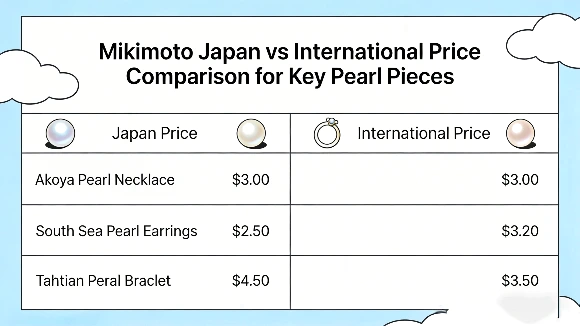
The savings from buying Mikimoto in Japan vary significantly by the type of pearl. Entry-level pieces, like Akoya pearl studs and small pendants, offer the most noticeable discounts—typically 15-25% lower than in the U.S. or Europe. For example, a pair of 6-7mm Akoya pearl studs cost around $1,500 in Japan (before tax refund), compared to $1,800-$2,000 in the U.S.
Mid-range pieces, like 16-inch Akoya pearl strands, are 12-18% cheaper in Japan, while high-end pieces (like Hanadama Akoya strands or South Sea pearl jewelry) offer 10-15% savings. Limited-edition or custom pieces, however, have consistent global pricing to maintain exclusivity, so Is it cheaper to buy Mikimoto pearls in Japan is less relevant for these luxury items. To understand how material quality impacts jewelry pricing, read the costume jewelry guide.
1.2. Currency Exchange Rates: A Hidden Savings Factor
Currency exchange rates play a critical role in whether Is it cheaper to buy Mikimoto pearls in Japan for international shoppers. When the Japanese yen is weak relative to the U.S. dollar, euro, or other currencies, savings increase dramatically. For example, if the yen is at a 10-year low, a $2,000 Mikimoto pendant in Japan could cost $1,400 in U.S. dollars—boosting savings to 30%.
Conversely, a strong yen narrows the price gap, with savings dropping to 5-10%. It’s essential to check exchange rates before planning a purchase, as they can turn a great deal into a negligible one. This makes Is it cheaper to buy Mikimoto pearls in Japan a dynamic question that changes with global economic conditions. To verify the quality of gold settings in Mikimoto pieces (regardless of where you buy), use the real gold test guide.
2. Key Factors That Make Mikimoto Cheaper in Japan
To fully understand Is it cheaper to buy Mikimoto pearls in Japan, it’s important to unpack the factors that drive the price difference. Japan’s unique position as Mikimoto’s home country creates cost advantages that translate to lower prices for shoppers.
2.1. Local Production & Reduced Overhead
Mikimoto’s headquarters, pearl farms, and workshops are all located in Japan, which eliminates expensive import fees, international shipping costs, and customs duties that add to prices in other countries. Additionally, retail overhead in Japan (for Mikimoto’s flagship stores) is often lower than in major U.S. or European cities, allowing the brand to pass on savings to consumers.
This local production streamlines the supply chain, cutting down on costs that would otherwise be passed to shoppers. Unlike brands that manufacture abroad and import to their home countries, Mikimoto’s Japanese production gives it a cost edge—directly contributing to why Is it cheaper to buy Mikimoto pearls in Japan is often yes. For a look at affordable alternatives to solid gold settings (similar to some Mikimoto designs), check the gold filled jewelry guide.
2.2. Brand Strategy & Market Positioning
Mikimoto positions itself as a national treasure in Japan, and its pricing reflects a balance between luxury and accessibility. While it’s still a high-end brand, Mikimoto offers slightly lower prices in Japan to make its pearls more accessible to local consumers and tourists. This strategy also reinforces its reputation as a Japanese luxury icon.
In contrast, Mikimoto’s pricing in other countries includes additional markups to account for local market demand, retail partnerships, and brand positioning as an exclusive import. This difference in strategy further solidifies why Is it cheaper to buy Mikimoto pearls in Japan for most shoppers.
3. Tax Refunds & Duty-Free Shopping: Maximize Savings in Japan
Even if it’s cheaper to buy Mikimoto pearls in Japan, the biggest savings come from tax refunds and duty-free shopping—perks that international shoppers can leverage to lower their final cost even more. These benefits turn modest savings into significant discounts.
3.1. Japan’s Tax Refund Policy for Foreign Shoppers
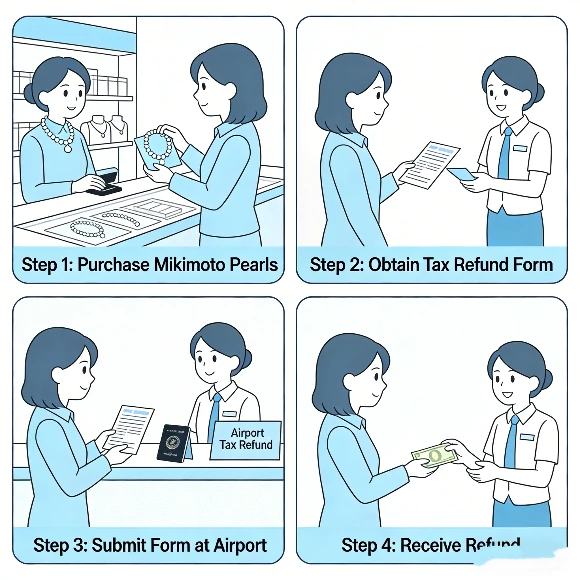
Japan offers a 10% consumption tax refund for foreign visitors on purchases over 5,000 yen (approximately $33). All Mikimoto stores in Japan participate in this program, so shoppers can get 10% back on their purchase by showing their passport and completing simple paperwork.
For example, a Mikimoto pearl strand that costs 200,000 yen (about $1,330) before tax becomes 180,000 yen (about $1,200) after the refund—adding to the 10-25% base price savings. This refund is a game-changer for answering Is it cheaper to buy Mikimoto pearls in Japan, as it boosts total savings to 20-35% for many pieces.
3.2. Duty-Free Shopping: Additional Savings
Many Mikimoto stores in Japan (especially in tourist areas like Ginza, Osaka, and Kyoto) are duty-free, meaning shoppers can avoid paying additional import duties that would apply if they bought the piece abroad. Duty-free savings typically add 5-10% to the total discount, making the answer to Is it cheaper to buy Mikimoto pearls in Japan even more compelling.
To qualify, you must be a foreign visitor, show your passport, and declare the item when leaving Japan. Duty-free items must be kept in their original packaging and not used in Japan before departure. Combining tax refunds and duty-free shopping maximizes savings, making Japan the most affordable place to buy Mikimoto for eligible shoppers.
4. Japan vs. Global Markets: Mikimoto Price Breakdown
To put the savings in perspective, comparing Mikimoto’s prices in Japan to other major markets helps confirm whether Is it cheaper to buy Mikimoto pearls in Japan is true for your location. This comparison shows exactly how much you can save by buying in Japan.
4.1. Japan vs. United States: Price Comparison
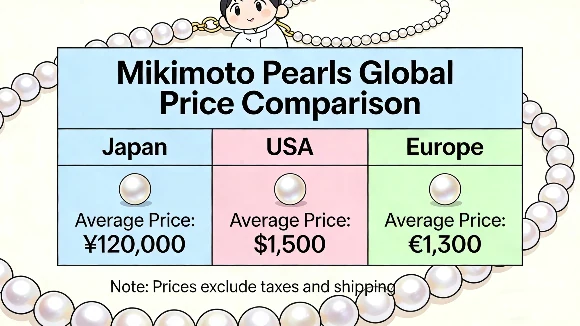
Mikimoto prices in the U.S. are typically 15-25% higher than in Japan, even after accounting for currency exchange rates. A 16-inch strand of 8-9mm Akoya pearls costs around $8,000 in the U.S., compared to $6,500-$7,000 in Japan (before tax refund). After the 10% tax refund, the Japan price drops to $5,850-$6,300—saving $1,700-$2,150.
Entry-level pieces offer even bigger percentage savings: a pair of 6mm Akoya studs cost $1,500 in Japan (after refund) vs. $1,800-$2,000 in the U.S.—a 10-20% discount. This gap confirms that Is it cheaper to buy Mikimoto pearls in Japan is true for U.S. shoppers. To compare with another modern luxury brand’s global pricing, read the Mejuri real gold guide.
4.2. Japan vs. Europe & Other Asian Markets
Mikimoto prices in Europe are similar to the U.S., with 15-20% higher prices than in Japan. Countries like France and the UK add a 20%+ VAT (value-added tax), though some offer tax refunds for tourists. Even with VAT refunds, Europe’s prices are still higher than Japan’s.
In other Asian markets (like South Korea or Singapore), Mikimoto prices are slightly lower than in the U.S. and Europe but still 5-10% higher than in Japan. This makes Japan the most affordable place to buy Mikimoto for most global shoppers, solidifying the answer to Is it cheaper to buy Mikimoto pearls in Japan.
Conclusion
After analyzing pricing, tax refunds, duty-free perks, and global comparisons, the answer to Is it cheaper to buy Mikimoto pearls in Japan is a clear yes—for most shoppers. Mikimoto’s base prices in Japan are 10-25% lower than in other countries, and when combined with Japan’s 10% tax refund and duty-free savings, total discounts can reach 20-35% for eligible visitors.
The savings are most significant for entry-level and mid-range pieces, while high-end and limited-edition pieces have smaller price gaps. Currency exchange rates play a role, but even in a strong yen environment, Japan remains the most affordable place to buy Mikimoto for international shoppers.
For anyone planning a trip to Japan or looking to save on Mikimoto, buying in Japan is a smart choice—just remember to take advantage of tax refunds and duty-free shopping to maximize your savings. The answer to Is it cheaper to buy Mikimoto pearls in Japan isn’t just yes; it’s a practical way to own the world’s finest pearls at a more accessible price.
Related Reading
For insights into another modern luxury jewelry brand’s material quality and pricing, check the Mejuri real gold guide. For tips on verifying gold jewelry quality (critical for any luxury purchase), revisit the real gold test guide.
- Is Mikimoto a luxury brand? The Definitive Luxury Jewelry Guide - Post Date: 2026-04-02
- How to clean Mikimoto pearls? The Safe Luxury Pearl Care Guide - Post Date: 2026-04-02
- How much is the Mikimoto crown? The Ultimate Luxury Crown Price Guide - Post Date: 2026-04-02
- Does Mikimoto ever go on sale? The Truth About Luxury Pearl Discounts - Post Date: 2026-04-02
- Is Mikimoto cheaper in Japan? A Complete Price Comparison Guide - Post Date: 2026-04-02
- Why are Mikimoto pearls so expensive? The Luxury Pearl Price Breakdown - Post Date: 2026-04-02
- How much are Mikimoto pearls worth? A Complete Value Breakdown - Post Date: 2026-04-02
- Are Mikimoto pearls valuable? A Complete Guide to Their Worth - Post Date: 2026-04-02
- Are Mikimoto pearls worth it? The Ultimate Luxury Pearl Investment Guide - Post Date: 2026-04-02
- Why are Mikimoto so expensive? The Iconic Luxury Pearl Legacy - Post Date: 2026-04-01
- Why is Cartier so expensive?What is special about Cartier? - Post Date: 2026-03-15
- skyworth tv is what brand?skyworth tv is it easy to use for? - Post Date: 2026-03-11
- Why is Van Cleef so expensive?Is Cartier or Van Cleef cheaper? - Post Date: 2026-03-17
- Why is Graff so expensive?Is Graff a high-end jewelry brand? - Post Date: 2026-03-18
- Is Cartier worth the money?Which is more expensive cartier or bvlgari jewelry? - Post Date: 2026-03-17
- 925 Silver vs Stainless Steel Jewelry - Post Date: 2026-03-20
- Is Bulgari a Luxury Brand?Is Bulgari higher than Cartier? - Post Date: 2026-03-18
- Why is Tiffany so expensive now?Is Tiffany considered a luxury brand? - Post Date: 2026-03-17
- Dreame brand is from which country?Is Dreame owned by Xiaomi? - Post Date: 2026-03-15
- How does the Pigeon brand ensure product safety - Post Date: 2026-03-17
- Is Mikimoto a luxury brand? The Definitive Luxury Jewelry Guide - Post Date: 2026-04-02
- How to clean Mikimoto pearls? The Safe Luxury Pearl Care Guide - Post Date: 2026-04-02
- How much is the Mikimoto crown? The Ultimate Luxury Crown Price Guide - Post Date: 2026-04-02
- Does Mikimoto ever go on sale? The Truth About Luxury Pearl Discounts - Post Date: 2026-04-02
- Is Mikimoto cheaper in Japan? A Complete Price Comparison Guide - Post Date: 2026-04-02
- Why are Mikimoto pearls so expensive? The Luxury Pearl Price Breakdown - Post Date: 2026-04-02
- How much are Mikimoto pearls worth? A Complete Value Breakdown - Post Date: 2026-04-02
- Are Mikimoto pearls valuable? A Complete Guide to Their Worth - Post Date: 2026-04-02
- Are Mikimoto pearls worth it? The Ultimate Luxury Pearl Investment Guide - Post Date: 2026-04-02
- Why are Mikimoto so expensive? The Iconic Luxury Pearl Legacy - Post Date: 2026-04-01