
Which is more luxury Cartier or Tiffany
Which is more luxury Cartier or Tiffany?Cartier.Because within the widely accepted evaluation system of the global ultra-luxury circle,Cartier outperforms Tiffany&Co.overall in terms of comprehensive luxury positioning,historical heritage,and the ceiling of its high-end lines.
Which is more luxury Cartier or Tiffany?Cartier.Because within the widely accepted evaluation system of the global ultra-luxury circle,Cartier outperforms Tiffany&Co.overall in terms of comprehensive luxury positioning,historical heritage,and the ceiling of its high-end lines.
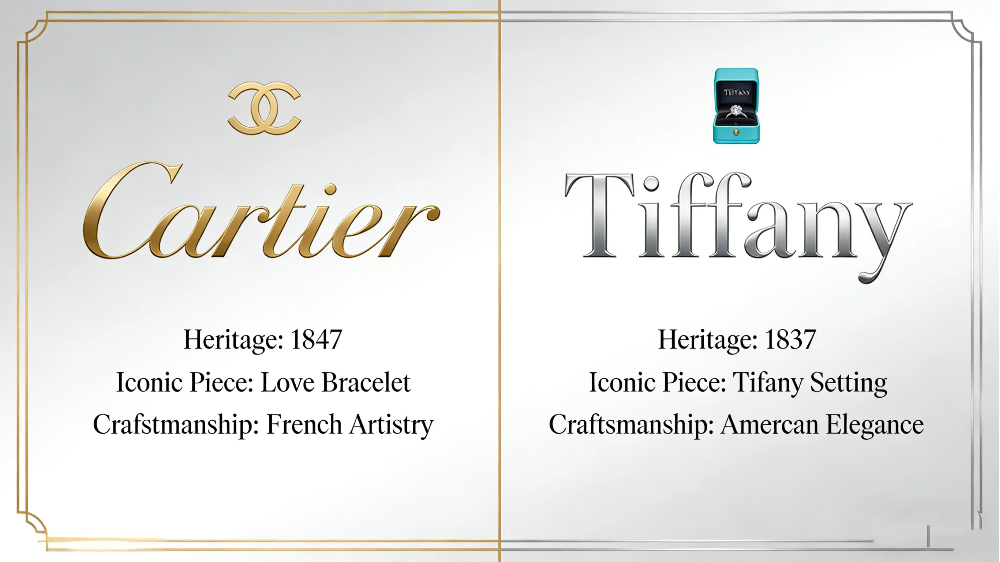
There are significant differences between Cartier and Tiffany&Co.in their respective luxury market niches,core strengths,and audience perception.There is no absolute dominance,and both hold an unshakable ultra-luxury status in their core areas of expertise.
1.Core Hard Strength Comparison That Defines the Luxury Tier of Cartier and Tiffany&Co.
1.1.Historical Heritage and Endorsement from Top Royal and Elite Circles
1.1.1.Cartier
Founded in Paris,France in 1847,Cartier was the official jeweler to European royal families,hailed by King Edward VII of the United Kingdom as”the jeweler of kings and the king of jewelers”—and it is precisely this century-old royal heritage that has led countless people to constantly ask:Which is more luxury Cartier or Tiffany?It has created crowns,scepters,and custom royal jewelry for the royal families of dozens of countries,including the United Kingdom,France,Russia,and Spain.With a century-long royal lineage endorsement,it is a recognized ultra-luxury jewelry benchmark for European nobility and the world’s top elite circles.This exclusive,century-long validation from royalty and the global elite is the core foundation of its luxury cachet.
1.1.2.Tiffany&Co.
Founded in New York,USA in 1837,10 years earlier than Cartier,Tiffany&Co.is fundamentally the epitome of American luxury.The vastly different origins of the two brands have led the public to constantly discuss Which is more luxury Cartier or TiffanyIt initially broke into the mainstream through America’s domestic elite circles and Hollywood culture,without the century-long royal warrant heritage of its European counterpart.Its core identity is”a symbol of American elite romance and luxury”,rather than an exclusive royal-grade luxury house for the global elite.Even in its peak 1980s era,it expanded through America’s middle class and elite circles,establishing its position as an American ultra-luxury brand,rather than a global royal-grade luxury house.
1.2.Product Ceiling and Upper Limit of Luxury
1.2.1.Cartier
Cartier has an exceptionally high luxury ceiling,with core competitive barriers spanning three major categories:High Jewelry,complicated function timepieces,and royal-grade custom jewelry—and the height of a brand’s product ceiling is precisely the core key to answering Which is more luxury Cartier or TiffanyIts High Jewelry collections consistently center on rare large-carat fancy colored diamonds and legendary gemstones,with individual pieces often priced in the tens of millions,even hundreds of millions of dollars.Its iconic Panthère de Cartier collection,Tutti Frutti collection,and royal custom pieces are highly sought-after collectibles for the world’s top billionaires and royal families.In watchmaking,Cartier is one of the few brands with both top-tier jewelry craftsmanship and in-house complicated movement capabilities,ranking in the top tier of the Swiss watch industry.Its luxury coverage spans from everyday wear pieces to collectible timepieces worth tens of millions of dollars,delivering full-spectrum ultra-luxury with no gaps.
1.2.2.Tiffany&Co.
Tiffany&Co.’s traditional strengths lie firmly in engagement rings and everyday fine jewelry.Its Tiffany Setting six-prong engagement ring is the global benchmark for bridal jewelry,and it dominated the North American engagement ring market with this core piece in the 1980s.The difference in product portfolio between the two brands has led more people to want to figure out Which is more luxury Cartier or TiffanyHowever,its high-end line ceiling was significantly lower than Cartier’s for many years,with High Jewelry and complicated function watches being long-standing weaknesses.It was not until its acquisition by LVMH in 2021 that it began to fully invest in its High Jewelry category.Between 2024 and 2026,it launched a number of High Jewelry pieces worth tens of millions of dollars,acquired legendary rough diamonds,and closed the gap in its high-end watchmaking business.While its high-end ceiling has rapidly caught up,it still lags significantly behind Cartier in terms of historical accumulation and recognition within the world’s top High Jewelry circles.
1.3.Brand Positioning and Price Range Coverage
1.3.1.Cartier
Cartier is positioned as a full-spectrum ultra-luxury brand with no gaps.It has almost completely eliminated low-priced entry-level lines,with its most accessible entry pieces(such as the base rings from the LOVE collection and Juste un Clou collection)carrying an official retail price generally above$2,800.It has no large-scale downmarket silver lines,maintaining its ultra-luxury positioning from entry-level pieces all the way to top-tier High Jewelry,with no brand downscaling.Its clientele ranges from high-net-worth individuals to royal families and the world’s top billionaires,delivering a far purer ultra-luxury circle exclusivity.And the difference in brand positioning is precisely one of the core dimensions when people discuss Which is more luxury Cartier or Tiffany
1.3.2.Tiffany&Co.
Tiffany&Co.long operated a dual-track system of ultra-luxury and accessible luxury.As early as the 1980s,it launched an entry-level silver line tailored for working women,and later expanded massively downmarket with its Return to Tiffany silver collection,with entry-level pieces having an official retail price as low as a few hundred dollars,accessible to the mass middle class.This diluted its top-tier luxury cachet to a certain extent,which has also led many people to use this as a basis to discuss Which is more luxury Cartier or TiffanyAfter 2021,LVMH drove a strategic shift away from the mid-market,cutting a large number of low-priced silver lines and raising the entry threshold.However,in public perception,Tiffany&Co.still has a lower entry barrier than Cartier,with slightly weaker purity in its ultra-luxury circle exclusivity.
2.The Irreplaceable Luxury Strengths of Cartier and Tiffany&Co.
2.1.Cartier’s Key Luxury Strengths
Globally recognized top-tier luxury credibility,century-long royal heritage,full-category ultra-luxury coverage,and stronger liquidity and value retention.
Whether in Europe,the Middle East,China,or North America,Cartier is universally recognized as a top-tier ultra-luxury jewelry house.For formal business settings,collectible investment,and cross-circle status signaling,Cartier’s luxury credibility is almost universal,which also answers the question of Which is more luxury Cartier or Tiffanywith the consensus of the global market.In the pre-owned market,pieces of the same level from Cartier generally have higher liquidity and value retention than those from Tiffany&Co.
2.2.Tiffany&Co.’s Key Luxury Strengths
The ultimate embodiment of American ultra-luxury,the absolute benchmark in the bridal jewelry category,and youthful,trend-driven luxury appeal.
In the North American market,Tiffany&Co.has extremely high national recognition and luxury credibility,having become a staple for America’s elite class as early as the 1980s.This has also led many North American consumers to have a completely different perspective when considering Which is more luxury Cartier or TiffanyIn the engagement ring category,the Tiffany Setting six-prong design is the industry benchmark,with its luxury deeply intertwined with romantic ritual,cementing its place in the public consciousness.In recent years,it has amplified its youthful luxury appeal through cross-brand collaborations with trendsetting labels including Supreme and Rimowa,matching and even surpassing Cartier’s popularity among young high-net-worth individuals worldwide.
3.Scenario-Based Recommendations for Choosing Between Cartier and Tiffany&Co.
If you are seeking universally recognized top-tier luxury credibility,royal-grade heritage,collectible investment value,and status signaling for formal occasions,Cartier is the preferred choice.This is also the most direct scenario-based answer to the question of Which is more luxury Cartier or Tiffany,as it has a higher overall luxury tier and universal circle recognition.
If you are seeking American elite luxury,exclusive romantic ritual for an engagement ring,timeless designs for everyday wear,and youthful,trend-driven ultra-luxury appeal,Tiffany&Co.is the preferred choice.In these areas,its luxury cachet and exclusive attributes are fully on par with,or even surpass,Cartier.
Further reading:
Why is Tiffany so expensive now
- How does Fred jewelry compare to Cartier? 2026 Luxury Jewelry Showdown - Post Date: 2026-04-01
- Does Cartier Jewelry Hold Its Value Well? Full Resale & Investment Guide - Post Date: 2026-03-29
- How to put on cartier love bracelet - Post Date: 2026-03-24
- Do cartier bracelets scratch - Post Date: 2026-03-24
- Where are cartier glasses made - Post Date: 2026-03-24
- How to unscrew cartier love bracelet - Post Date: 2026-03-23
- What happened to Tiffany from the 80s - Post Date: 2026-03-19
- What is the cheapest jewelry at Cartier - Post Date: 2026-03-19
- What is the most expensive Cartier jewelry - Post Date: 2026-03-19
- Is Bulgari a Luxury Brand?Is Bulgari higher than Cartier? - Post Date: 2026-03-18
- Why is Cartier so expensive?What is special about Cartier? - Post Date: 2026-03-15
- skyworth tv is what brand?skyworth tv is it easy to use for? - Post Date: 2026-03-11
- Why is Van Cleef so expensive?Is Cartier or Van Cleef cheaper? - Post Date: 2026-03-17
- Why is Graff so expensive?Is Graff a high-end jewelry brand? - Post Date: 2026-03-18
- Is Cartier worth the money?Which is more expensive cartier or bvlgari jewelry? - Post Date: 2026-03-17
- 925 Silver vs Stainless Steel Jewelry - Post Date: 2026-03-20
- Is Bulgari a Luxury Brand?Is Bulgari higher than Cartier? - Post Date: 2026-03-18
- Why is Tiffany so expensive now?Is Tiffany considered a luxury brand? - Post Date: 2026-03-17
- Dreame brand is from which country?Is Dreame owned by Xiaomi? - Post Date: 2026-03-15
- How does the Pigeon brand ensure product safety - Post Date: 2026-03-17
- Is David Morris a luxury brand? Timeless Craftsmanship That Defines Elite Luxury - Post Date: 2026-04-04
- Who is the designer of Belperron jewelry? The Visionary Who Redefined Luxury - Post Date: 2026-04-04
- What makes Belperron jewelry unique? Fascinating Design Secrets Collectors Adore - Post Date: 2026-04-04
- Is Fred Jewelry under LVMH? Clear Ownership & Brand History Guide - Post Date: 2026-04-04
- Why is Boucheron so Expensive? Craftsmanship & Series That Justify the Price - Post Date: 2026-04-04
- Is Boucheron or Mellerio Older? Fascinating Age Comparison of Iconic Brands - Post Date: 2026-04-04
- When was Boucheron Founded? Fascinating Historical Origins Revealed - Post Date: 2026-04-04
- Is Boucheron a Luxury Brand? Expert Verdict & Analysis - Post Date: 2026-04-04
- Is Damiani a Luxury Brand? A Complete Expert Analysis - Post Date: 2026-04-04
- How much is Graff Diamonds worth? Honest Value Breakdown - Post Date: 2026-04-04