skyworth tv is what brand?skyworth tv is it easy to use for?
Skyworth tv is what brand?It is the core independent brand under China's Skyworth Group. It is a home appliance brand, specializing in televisions, refrigerators, washing machines, etc. Is Skyworth TV good to use?Overall,it is very user-friendly and offers excellent value for money, it is good to use and offers high cost-effectiveness.
Skyworth tv is what brand?It is the core independent brand under China’s Skyworth Group. It is a home appliance brand, specializing in televisions, refrigerators, washing machines, etc. Is Skyworth TV good to use?Overall,it is very user-friendly and offers excellent value for money, it is good to use and offers high cost-effectiveness.
1.Skyworth tv is what brand?
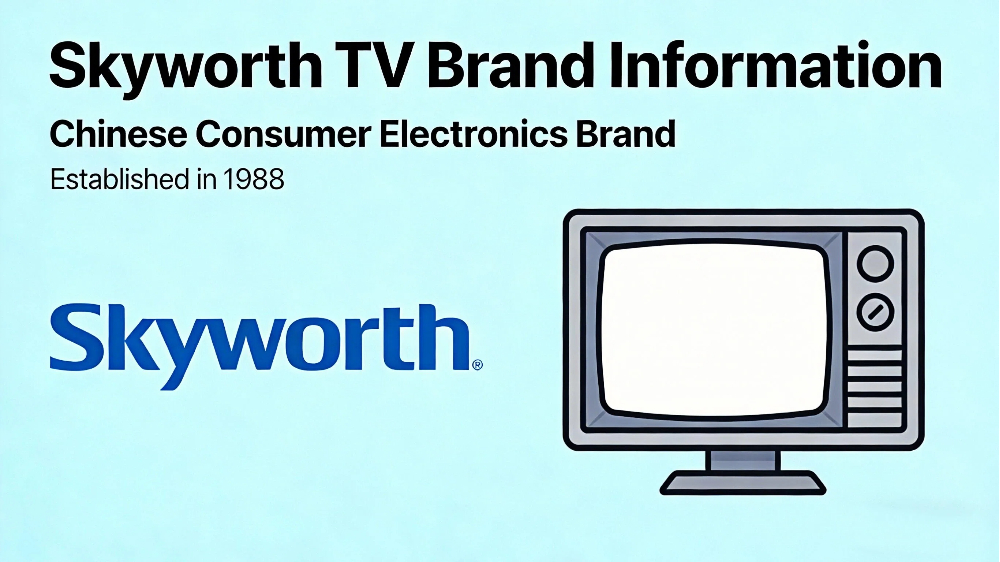
Skyworth TV is the core independent brand under China’s Skyworth Group,a leading domestic first-tier color TV brand with 38 years of in-depth experience in the display field.It is also a top-tier global TV manufacturer,a National Demonstration Enterprise for Individual Champion of the Manufacturing Industry,by no means a foreign OEM brand,and a benchmark national brand in China’s home appliance industry.
1.1 Brand Basics and Official Ownership
Skyworth TV is owned by Skyworth Group,founded in 1988 by Huang Hongsheng and headquartered in Shenzhen,Guangdong Province.The group owns two listed companies:Skyworth Group(HK.00751)and Skyworth Digital(SZ.000810).It has ranked among the top 100 electronic enterprises in China for many consecutive years and is one of the first batch of demonstration units for”Made in China 2025″.
“Skyworth”is its official global English brand name.It also has two sub-brands:coocaa,which targets the young internet market,and METZ,a high-end German TV brand,forming a complete brand matrix.
1.2 Market Position
Firmly in the top tier of the domestic market and ranked among the first echelon globally.
1.2.1 Domestic Market
Skyworth TV has long ranked among the top 3 in China’s color TV market by both retail volume and sales revenue.It is an absolute benchmark in the wallpaper TV and 100-inch large-screen TV segments.In 2024,it won the dual championship of China’s sales volume for 100-inch LCD TVs and wallpaper TVs,and its Mini LED category growth rate has consistently ranked first in the industry.
1.2.2 Global Market
In 2025,Skyworth TV surpassed Sony with a 5.8%share of global sales revenue,making a historic entry into the top 5 global TV brands by sales revenue.Its products are sold in more than 120 countries and regions around the world.In 2026,it officially took over Panasonic’s TV business in Europe and North America,and also holds the exclusive operation right for Philips TV in North America,with its global layout continuing to deepen.
1.3 Core Hard Strength:Self-developed Technology Builds the Brand’s Moat
The core competitiveness of Skyworth TV comes from full-chain independent technology research and development,and it is by no means a simple hardware assembly brand.
1.3.1 Benchmark in Display Technology
It is one of the first brands in China to lay out OLED TVs,and also the pioneer of the wallpaper TV category,with 8 years of in-depth development in this field.It holds 418 patents related to ultra-thin heat dissipation,solving the industry’s long-standing dilemma of”balancing an ultra-slim body with flagship performance”.At the same time,it continues to lead in the fields of Mini LED,8K UHD,QD Quantum Dot and other technologies.Its flagship models are equipped with the self-developed Chameleon AI Picture Quality Chip,realizing intelligent optimization and ultimate restoration of picture quality.
1.3.2 Full Industrial Chain Independent Capability
It has 16 major manufacturing bases in Shenzhen,Nanjing,Inner Mongolia and overseas,with independent R&D and production of complete machine products.At the same time,it has developed the Coocaa OS,a leading smart TV operating system in China,with more than 400 million accumulated users,realizing full end-to-end independent control over both hardware and system.
1.3.3 Differentiated Technical Advantages
It has formed exclusive barriers in the fields of healthy eye care,home aesthetics,and AI interaction.It is a pioneer in the eye care TV track in China.At the same time,it pioneered the four-sided bezel-less”Picture Boundary Screen”technology,which deeply integrates TV with home aesthetics,and has won many top industry honors such as the AWE Apland Innovation Award.
1.4 Full Price Range Product Line Layout
Skyworth TV covers the full consumption scenarios from entry-level affordable to flagship collectible models,with a clear core product line:
1.4.1 High-end Flagship Line
Including W series wallpaper TVs,S series OLED flagships,and Q series Mini LED high-end models,focusing on ultimate picture quality,home aesthetics and flagship performance,benchmarking against international high-end brands.
1.4.2 Mainstream Home Line
Including A series and G series,the main sales force of the brand,balancing picture quality,smart experience and high cost performance,covering mainstream usage scenarios such as family living rooms and bedrooms.
1.4.3 Entry-level Affordable Line
Including J series and P series,focusing on the thousand-yuan level market,suitable for lightweight needs such as rental housing,elderly rooms,and secondary bedrooms.
1.4.4 Sub-brand Line
coocaa focuses on the online young market with extreme cost performance;METZ focuses on the European high-end market,positioned as a professional audio-visual flagship.
1.5 Clarification of Common Misconceptions
1.5.1 Misconception:Skyworth is a foreign/joint venture brand
Clarification:Skyworth is a 100%Chinese local independent brand,with its headquarters,R&D and core production all in China.It is a fully independently operated national home appliance brand,with only branch production bases and sales channels overseas.
1.5.2 Misconception:Skyworth is an OEM brand with no core technology
Clarification:Skyworth has a complete independent R&D and manufacturing system,with self-developed picture quality chips,smart operating systems,and display patented technologies.It is a National Intellectual Property Demonstration Enterprise,by no means a brand relying on OEM from foundries.
Clarification:Coocaa is a wholly-owned sub-brand under Skyworth Group,sharing Skyworth’s supply chain,after-sales system and core technology.It only differs in positioning and target audience,and is not an unbranded or third-party brand.
2.skyworth tv is it easy to use?
Skyworth TV is overall easy to use and offers a high cost-performance ratio, making it suitable for most households. Especially for those who prioritize eye protection, smooth system performance, convenient after-sales service, and good looks, it is a very suitable choice.
Overall,Skyworth TV is extremely easy to get started with,and is a brand with maximum user-friendliness for users of all age groups among domestic first-tier TVs.It has layered usability optimizations for the elderly,children,young people,and audio-visual enthusiasts.The basic operations have zero learning curve,even digital novices can get started quickly;advanced functions have clear guidance,while also taking into account the customization needs of in-depth players.It is a TV brand with extremely strong family adaptability in the same price range.
2.1 Underlying Usability Design
Self-developed Coocaa OS reduces the operation threshold from the root.
All Skyworth TV models are equipped with the self-developed Coocaa OS,which is the core support for its ease of use,completely avoiding the pain points of cumbersome menus and chaotic logic of traditional smart TVs:
2.1.1 Minimalist Interface Logic,No Redundant Interference
The system adopts a flat layout.The default home page only retains core functions such as live broadcast,movies and TV,and commonly used apps.Complex advanced settings are all stored in secondary menus,which will not cause visual interference to novices.At the same time,it supports fully customizable home screen,allowing users to pin the functions and apps commonly used by the family to the home page without searching every time.
2.1.2 Boot Direct Access Function,Completely Say Goodbye to Cumbersome Steps
It supports setting the default boot launch item.For example,for the elderly,it can be set to directly boot to cable TV or live streaming apps,skipping the home screen and advertisements.After turning on,the picture will be displayed directly just like the old TV,with no additional operations required.
2.1.3 Empowered by AI Agent,Voice Can Complete the Whole Process of Settings
The 2026 models are upgraded with the Coocaa AI Super Agent.It can not only search for videos and adjust settings,but also directly ask”how to screen mirror”or”how to turn on senior mode”by voice.The TV will directly pop up the step-by-step tutorial,and even help you complete the settings with one click,completely solving the pain points of”can’t adjust,can’t find”.
2.2 Zero Threshold for Core Functions:Done with One Sentence or One Button
2.2.1 Full-scene Voice Control,Operable Without a Remote Control
This is the core ease-of-use highlight of Skyworth TV,and also the most commonly used function for the elderly and children:
All mid-to-high end models are equipped with standard far-field voice control.You don’t need to look for the remote control,just call”Xiaowei Xiaowei”to wake it up.It supports 10+meter long-distance voice pickup and 180°omni-directional recognition,with a recognition accuracy rate of 99.6%.It can respond accurately even when you speak in the kitchen or the corner of the living room.
It supports recognition of 23 Chinese dialects,including Cantonese,Sichuanese,Henan dialect,etc.Even the elderly who can’t speak Mandarin can use it normally.A sentence like”turn on CCTV-1″,”adjust the volume to 30″,”what’s the weather tomorrow”can get an instant response.
It has full function coverage:not only searching for videos and adjusting the volume,but also opening apps by voice,setting alarms,checking recipes,controlling smart home devices,and even directly activating senior mode and kids mode by voice,no need to press the remote control at all.
2.2.2 Screen Mirroring and Peripheral Connection,Done with One Click,No Threshold
The screen mirroring operation is extremely simple.The remote control has a built-in one-click screen mirroring button.Press it to pop up the operation guide.You can connect by turning on the wireless screen mirroring on your phone and selecting the TV name,no need to install third-party apps.It is fully compatible with iOS,Android,Huawei,and Xiaomi devices,and can instantly mirror photos,videos,and meeting documents with no delay or stutter.
After peripherals such as set-top boxes,gaming consoles,and USB drives are connected,the TV will automatically pop up an input source prompt,which can be switched with one click.No need to manually enter the settings to find the input source,even the elderly can operate it easily.
2.2.3 Optimized Remote Control,Even Novices Can Operate Blindly
It is equipped with a standard Bluetooth remote control,which can be operated without pointing at the TV,even when you are facing away from the TV or the remote is placed in the sofa gap.The button layout is minimalist,only retaining core buttons such as power,volume,channel,home,and return,no redundant complex buttons,and the elderly can quickly get started after picking it up.
The remote control of mid-to-high end models has customizable shortcut keys,which can pin the commonly used functions such as live broadcast,HDMI input source,and screen mirroring to the shortcut keys.You can access them with one press,no need to flip through layers of menus.
2.3 Layered Adaptation for All Groups:The Elderly,Children,and Young People Get What They Need
2.3.1 The Elderly/Digital Novices:Extreme Simplification,Zero Learning Cost
A dedicated Senior Mode(Silver Age Mode)is created.After one-click switching,it directly solves all the pain points of the elderly using smart TVs:
The interface is automatically simplified,with fonts and icons enlarged by more than 200%.Only the commonly used content for the elderly such as news,opera,square dance,and live broadcast are retained,all redundant functions are removed,and it is clear at a glance.
The voice broadcast function is turned on,and the selected column will be read out automatically,so that the elderly with poor eyesight can use it normally.
It has a built-in family payment function.When the elderly encounter paid content,they don’t need to operate it themselves.Children can scan the code to bind the family number and pay remotely,avoiding accidental charges.
They can even directly call”Xiaowei Xiaowei,teach me how to use the TV”by voice,and the TV will automatically play voice+graphic tutorials,with someone”teaching”the whole process,no need to trouble children at all.
2.3.2 Children:Safe and Controllable,Easy to Operate,Worry-free for Parents
One-click to switch to Kids Mode.After entering,it automatically locks age-appropriate content,with built-in content rating,watch time control,and eye care reminders.Children can operate it by themselves,and parents don’t need to worry at all.At the same time,it has built-in AI education functions,including spoken English practice,picture book stories,and animated teaching,which is not only a TV but also a learning tool for children.
2.3.3 Young People/Family Main Users:Efficient and Convenient,Full Coverage of Entertainment and Office
One-click access to all scenarios including movies,KTV,games,and fitness.The app store covers most mainstream apps,with simple installation and uninstallation,consistent with the operation logic of mobile phones.
It supports a dual system for work and entertainment.One-click to switch to office mode,with built-in Tencent Meeting and WPS.The screen mirroring supports four-screen simultaneous display,which can be used directly for temporary work from home and customer reception,no need for additional equipment.
It supports smart home linkage,directly controlling smart devices such as air conditioners,robot vacuums,and lights by voice,turning the TV into a whole-home smart control hub with simple and convenient operation.
2.3.4 Audio-visual/Gaming Enthusiasts:Both Foolproof Optimization and Deep Customization
No need to manually adjust complex picture parameters.It has built-in AI picture quality optimization,one-click to switch between Movie,Sports,Gaming,and Eye Care modes.The TV will automatically adapt the brightness,contrast,and refresh rate,even novices can get flagship-level viewing experience.
One-click to turn on Gaming Mode,which automatically reduces input lag,adapts to consoles such as PS5 and Xbox,and the full-spec HDMI 2.1 ports are plug-and-play,no manual settings required.At the same time,it supports in-depth customization of picture and sound parameters to meet the professional needs of enthusiasts.
- Is Pandora a Luxury Brand: Clear Facts & Brand Positioning - Post Date: 2026-03-29
- What is Permanent Jewelry? The Best Guide 2026 - Post Date: 2026-03-26
- Is Van Cleef made out of real gold - Post Date: 2026-03-19
- Why is Harry Winston jewelry so expensive - Post Date: 2026-03-19
- What country is Bvlgari from?Is Bulgari a subsidiary of Louis Vuitton? - Post Date: 2026-03-19
- What happened to Tiffany from the 80s - Post Date: 2026-03-19
- Which is more luxury Cartier or Tiffany - Post Date: 2026-03-19
- What is the cheapest jewelry at Cartier - Post Date: 2026-03-19
- What is the most expensive Cartier jewelry - Post Date: 2026-03-19
- Is the cartier love ring worth it - Post Date: 2026-03-18
- Why is Cartier so expensive?What is special about Cartier? - Post Date: 2026-03-15
- skyworth tv is what brand?skyworth tv is it easy to use for? - Post Date: 2026-03-11
- Why is Van Cleef so expensive?Is Cartier or Van Cleef cheaper? - Post Date: 2026-03-17
- Why is Graff so expensive?Is Graff a high-end jewelry brand? - Post Date: 2026-03-18
- Is Cartier worth the money?Which is more expensive cartier or bvlgari jewelry? - Post Date: 2026-03-17
- 925 Silver vs Stainless Steel Jewelry - Post Date: 2026-03-20
- Is Bulgari a Luxury Brand?Is Bulgari higher than Cartier? - Post Date: 2026-03-18
- Why is Tiffany so expensive now?Is Tiffany considered a luxury brand? - Post Date: 2026-03-17
- Dreame brand is from which country?Is Dreame owned by Xiaomi? - Post Date: 2026-03-15
- How does the Pigeon brand ensure product safety - Post Date: 2026-03-17
- What is the trendiest jewelry right now? The Ultimate 2026 Guide - Post Date: 2026-03-30
- What are the Top 5 Jewellery Brands? The Ultimate Luxury Guide 2026 - Post Date: 2026-03-30
- What Celebrities Wear Mejuri? The Best Star Style Guide 2026 - Post Date: 2026-03-30
- Does Mejuri Use Real Gold? The Definitive Answer 2026 - Post Date: 2026-03-30
- Does Mejuri Make Custom Jewelry? The Honest Truth 2026 - Post Date: 2026-03-30
- Why is Mejuri so expensive now - Post Date: 2026-03-30
- Is Mejuri Good Jewelry? Honest Quality, Materials & Durability Review - Post Date: 2026-03-30
- Is Mejuri a Japanese Company? Full Brand Origin & History Guide - Post Date: 2026-03-30
- What Are Affordable Luxury Jewelry Brands? Best Accessible Luxury Brands Guide - Post Date: 2026-03-30
- Is Buccellati a Luxury Brand? The Honest Luxury Status & Heritage Guide - Post Date: 2026-03-30