Why is Yurman so expensive?Is David Yurman made in China?
Why is Yurman so expensive?It comes down to the uncopyable artist-level patented designs,ultra-strict material and gemstone standards,a cost-no-object handcraftsmanship barrier,a century of brand heritage among America’s top elite circles,and its rare positioning for all-scenario wear.Is Yurman made in China?None of its finished pieces are made in China;the core design,production,assembly,and quality control of all finished goods are completed exclusively in the United States and Italy.
Why is Yurman so expensive?It comes down to the uncopyable artist-level patented designs,ultra-strict material and gemstone standards,a cost-no-object handcraftsmanship barrier,a century of brand heritage among America’s top elite circles,and its rare positioning for all-scenario wear.Is Yurman made in China?None of its finished pieces are made in China;the core design,production,assembly,and quality control of all finished goods are completed exclusively in the United States and Italy.
1.Why is Yurman so expensive?
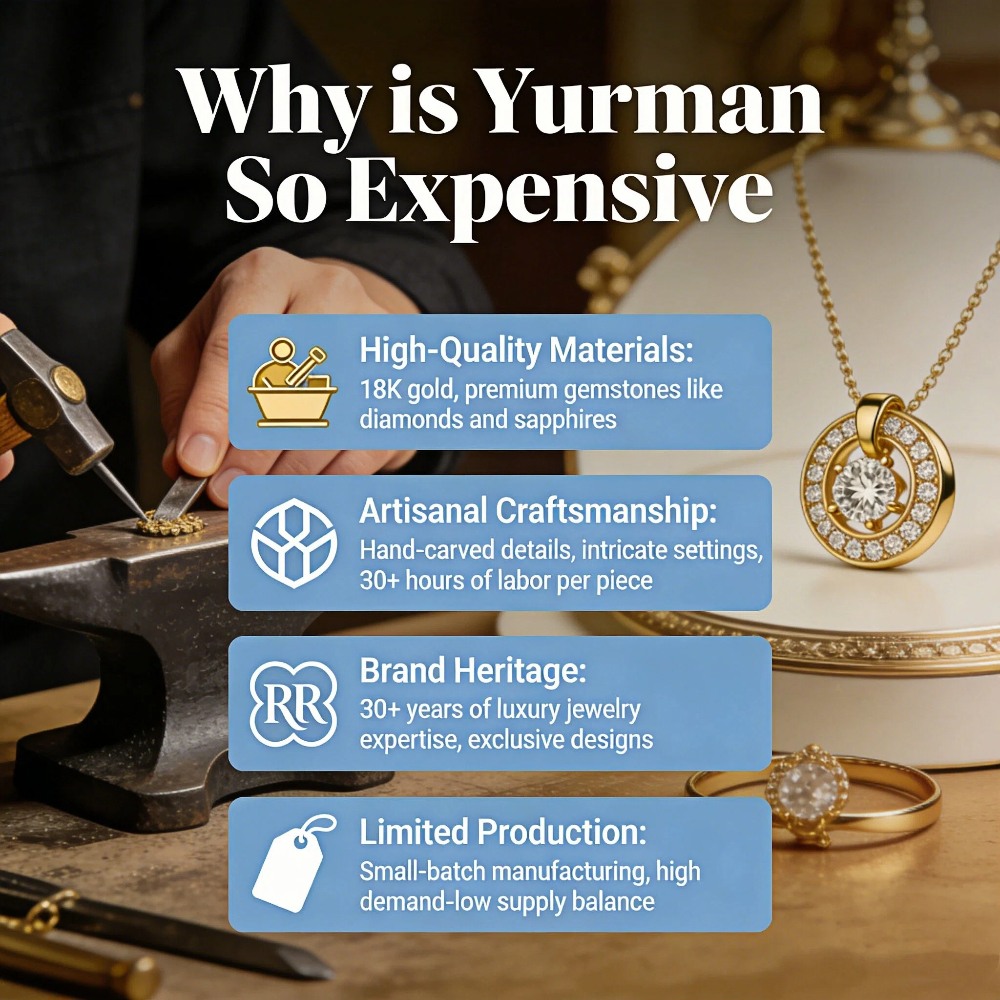
The premium price of Yurman stems from its status as the benchmark of American homegrown ultra-luxury jewelry,a globally recognized synonym for American fine jewelry,on par with Tiffany&Co.It is even known in the industry as”the Graff of silver jewelry”.Its high price is the ultimate combination of uncopyable artist-level patented designs,ultra-strict material and gemstone standards,a cost-no-object handcraftsmanship barrier,a century of brand heritage among America’s top elite circles,and its rare positioning for all-scenario wear.It has completely broken the aesthetic monopoly of traditional European jewelry and created an exclusive ultra-luxury track of its own.
1.1.Uncopyable Patented Designs
The core of a jewelry’s premium value first lies in its unique,irreplicable design soul,and Yurman’s designs have completely reshaped the landscape of American jewelry from the moment they were created.
1.1.1.Iconic Patented Cable Design,Unmatched Global Recognizability
The brand’s founder,David Yurman,is a sculptor by training,and his wife Sybil is a painter.In 1983,they launched the first Cable bracelet,inspired by the torque necklaces of ancient Greece and Rome and the steel cables of New York’s Brooklyn Bridge,perfectly blending the three-dimensional lines of sculptural art with fine jewelry.This design was patented as soon as it was released,becoming the signature element running through all of the brand’s collections,and one of the most recognizable classic designs in the global jewelry industry.
Its core barrier lies in this:for the seemingly simple twisted rope pattern,the curvature,thickness,and light and shadow effect of each spiral have been polished countless times.It must not only present the sculptural sense of strength,but also ensure extreme wearing comfort.Countless counterfeits on the market can only copy its shape,but can never replicate the texture and wearing experience of the original.
1.1.2.Exclusive Patented DY Signature Cut,Redefining Gemstone Brilliance
The brand holds an exclusive patented gemstone cutting process,which combines the advantages of cushion cut and round brilliant cut.With sharper corners and more precise facet proportions,it can maximize the fire and brilliance of the gemstone.It is exclusive to Yurman and serves as the core technical barrier of the brand’s design.
At the same time,the brand’s Silver Ice Collection,launched in 1997,was the first to subvert the industry convention that traditional luxury jewelry only sets diamonds in precious metals.It pioneered the setting of diamonds in sterling silver,completely breaking the material boundary of jewelry and creating a brand-new category of”American designer jewelry”,with an irreplaceable position in the industry.
1.1.3.”From the Red Carpet to the Kitchen Counter”All-Scenario Design Philosophy,Precisely Meeting the Needs of High-End Users
Most traditional European ultra-luxury jewelry is only suitable for formal occasions such as banquets and red carpets,and has a strong sense of incongruity in daily wear.Yurman,however,set a core design philosophy from its inception:jewelry should be an all-day companion,suitable for both the top red carpet and daily commuting and casual scenarios.
Its design balances luxurious texture and practicality.Bracelets,rings,and necklaces are all made to not snag fabric,not pinch the skin,and be comfortable for daily wear.Even the clasp features an exclusive patented one-hand operable design,completely solving the pain point of inconvenient wearing of high-end jewelry.This unique design positioning has made it the most frequently worn ultra-luxury jewelry among high-net-worth individuals in Europe and America,and also gives its premium an irreplaceable practical value support.
1.2.Ultra-Strict Material and Gemstone Standards,Zero-Compromise Quality Control Bottom Line
Yurman’s high price never comes from selling design alone.Its screening standards for materials and gemstones are fully on par with the ultra-luxury brands at the top of the pyramid,such as Harry Winston and Graff,far exceeding those of ordinary high-end jewelry brands.
1.2.1.Ultimate Quality Control for Precious Metals
For all products across the brand’s entire line,even entry-level sterling silver pieces,only the highest grade 925 sterling silver is used,with exclusive anti-tarnish treatment,far exceeding the texture and durability of ordinary silver jewelry.All precious metal pieces use 18K yellow gold,rose gold,and white gold,with no lower purity materials such as 14K.The metal ratio and polishing precision of each piece have been tested hundreds of times to ensure that the original texture and luster are maintained even after years of wear.
1.2.2.Industry-Ceiling Screening Standards for Diamonds and Colored Gemstones
For diamonds:All diamonds used across the brand’s line are only natural diamonds of G-H color,VS clarity and above,strictly in compliance with the Kimberley Process,100%conflict-free.Each diamond is screened layer by layer by senior gemologists,with all cuts reaching Excellent grade.Even for accent diamonds as small as 0.01 carats,the standards are never lowered.The High Jewelry Collection only uses top-tier D color,FL/IF clarity white diamonds,with standards fully aligned with ultra-luxury brands.
For colored gemstones:The brand only uses unheated/very minimally heated,collectible colored gemstones with top color grades,including Muzo green emeralds,pigeon blood rubies,royal blue sapphires,and Paraiba tourmalines.It even makes special trips to mining areas around the world to source batches of top gemstones.The most representative Aquamarine and Diamond Necklace,set with a 238-carat top aquamarine and 70 carats of fine diamonds,has a retail price of up to HK$15.5 million and is a regular at global auction houses.
1.3.Cost-No-Object Handcraftsmanship,A Century-Honed Technical Barrier
All Yurman pieces,from design to finished product,adhere to full handcrafting throughout the entire process,with zero mass production assembly lines.The extreme craftsmanship cost is the core support for its high price.
1.3.1.Exclusive Workshop at New York Headquarters,Handcrafted by Master Artisans
The brand has an exclusive workshop at its New York headquarters,with a team of craftsmen with an average of more than 20 years of industry experience.Many craftsmen dedicate their entire lives to a single process.From design prototyping,wax carving,metal polishing,stone setting to final polishing,the entire process is completed by hand.Even the most basic entry-level ring goes through hundreds of manual processes.
A single Cable bracelet requires dozens of man-hours of manual polishing for the twisted rope pattern alone;a single high jewelry piece requires hundreds to thousands of man-hours,taking months to years to complete,with labor costs alone reaching an astronomical sum.
1.3.2.Extreme Setting Craftsmanship,Zero Margin for Error
The brand’s iconic invisible setting and pavésetting techniques can hide the metal prongs to the greatest extent,fully releasing the fire of the gemstones,while ensuring the firmness of the setting,so that the stones will not fall out even after decades of daily wear.The angle of each accent diamond and the tightness of the setting are adjusted hundreds of times by the craftsman,with no defects allowed.The extreme craftsmanship details can never be replicated by ordinary mass-produced jewelry.
1.4.Irreplicable Brand Moat
Synonymous with American Ultra-Luxury,Exclusive Endorsements from Top Elite Circles
1.4.1.Brand Heritage with Artist DNA,The Benchmark of American Ultra-Luxury Jewelry
In 1979-1980,David Yurman and his wife Sybil Yurman founded the brand in New York.With the artist combination of a sculptor and a painter,they completely broke the monopoly of European jewelry brands on the high-end jewelry market,becoming the first American homegrown jewelry brand that can compete with century-old European ultra-luxury brands.In the U.S.domestic market,its high-end positioning and popularity are fully on par with Tiffany&Co.
To this day,the brand is still core-operated by the founding family,free from the commercial performance constraints of the three major conglomerates:LVMH,Richemont,and Kering.There is no need to launch cheap down-market lines for sales volume,upholding the brand’s ultra-luxury tone at its root.
1.4.2.Exclusive Endorsements from Global Top Elite Circles,Full Social Currency
The brand never engages in mass marketing.Its core clients are top billionaires in Europe and America,A-list Hollywood stars,and international supermodels.Angelina Jolie,Jessica Chastain,Gisele Bündchen,Kate Moss and many others are lifelong patrons of the brand.It is also a regular ultra-luxury jewelry on the Oscars and Cannes red carpets.Wearing Yurman is a symbol of status and taste for high-net-worth individuals in the United States and around the world.
At the same time,it is the most successful and mature brand in the men’s jewelry line among global ultra-luxury jewelry brands.From rings and bracelets to necklaces,it perfectly meets the daily wear needs of high-end men,and is the preferred brand of men’s jewelry for global billionaires and celebrities,further consolidating its ultra-luxury positioning.
1.5.Extreme Scarcity and Clear Price Threshold,Completely Setting It Apart from Ordinary High-End Brands
1.5.1.Extremely Low Production Volume,Virtually No Mass-Produced Bestsellers
The annual production volume of the brand’s entire product line is strictly controlled.Even popular basic styles are not mass-produced on a large scale.The vast majority of the High Jewelry Collection are one-of-a-kind pieces worldwide,exclusively custom-made for VIP clients,and will not be re-produced.You may not be able to buy the same style even if you have the money.This extreme scarcity directly drives up the premium and collection value of the pieces.
1.5.2.Clear Price Threshold,The Underlying Support for Ultra-Luxury Positioning
2026 global official retail price reference,which intuitively reflects the brand’s positioning and threshold:
Entry Threshold:Basic sterling silver pieces,official retail price$300-$2,000(approx.2,100-14,000 RMB);basic 18K gold pieces,official retail price starting from$2,000(approx.14,000 RMB and above);
Classic Core Collection:Cable collection bracelets,rings,necklaces,official retail price$3,000-$50,000(approx.21,000-350,000 RMB);
Top-Tier Collectible Line:One-of-a-kind high jewelry pieces,large-carat creations,official retail price ranging from hundreds of thousands of dollars to tens of millions of dollars,with most price quotes only available to high-net-worth VIP clients.The highest-end pieces have repeatedly set records at auction.
Many people mistakenly believe that”Yurman has sterling silver entry-level pieces,so it is not ultra-luxury”,which is a serious misunderstanding of the brand’s positioning.
Just as the launch of entry-level pieces by Cartier and Bulgari does not affect their ultra-luxury positioning,Yurman’s entry-level pieces are only to let more people access the brand’s design and craftsmanship.The core competitiveness of the brand has never been the entry-level silver jewelry,but its High Jewelry Collection,century-honed patented design,extreme handcraftsmanship,and recognition from the world’s top elite circles.Its silver jewelry is also the ultra-luxury ceiling in the silver jewelry category,with craftsmanship,texture,and quality control far exceeding ordinary affordable luxury silver jewelry brands.This is the core reason why even its entry-level pieces are much more expensive than similar products.
Yurman’s high price is never simple brand premium,but the perfect integration of artist-level design,extreme material standards,top-notch handcraftsmanship,and ultra-luxury brand heritage into a piece of jewelry that can be worn all day long.What it sells is not just a piece of jewelry,but a lifestyle unique to American ultra-luxury,a wearable work of art for daily use,and a globally recognized symbol of taste and status.This is the core reason why it can firmly stay in the global ultra-luxury jewelry echelon,with prices far exceeding ordinary high-end brands.
2.Is Yurman Made in China?
The core jewelry and watch mainline finished products of authentic David Yurman(commonly referred to simply as Yurman)are not made in China.The brand has never officially authorized any Chinese factory to produce its mainline finished products.Only a very small number of non-core packaging materials and accessories may be sourced from the global supply chain(including China),but the core design,production,assembly,and quality control of the finished products are all completed in the United States and Italy.
2.1.Core Production Base in the U.S.Domestic Market,Supplemented by High-End Workshops in Italy
As an American homegrown ultra-luxury jewelry brand,David Yurman’s headquarters and core design center are located in New York,USA.The design,prototyping,and final quality control of all products across the line are completed at the New York headquarters.The vast majority of the brand’s core jewelry and watch finished products are produced in exclusive workshops in the U.S.domestic market.Some styles with special requirements for metal craftsmanship are produced in top jewelry workshops in Italy,which is also the conventional layout of global ultra-luxury jewelry brands.
The product detail pages of authentic products from globally authorized official channels(such as the brand’s official website,official partner platforms like Farfetch)clearly mark”MADE IN USA”or”MADE IN ITALY”.The authentic physical products are also engraved with the corresponding origin mark on the metal part,without any exceptions.
2.2.Full-Process Quality Control Closed Loop,No Overseas Finished Product Contract Factories
The brand has extremely high requirements for confidentiality and quality control in the production process.The core processes such as the polishing of the Cable twisted pattern,patented cutting,and gemstone setting are exclusively completed by senior craftsmen signed by the brand.It has never outsourced the finished product production process to any Chinese factory,and there is no so-called”official Chinese contract factory”
- Who is the designer of Belperron jewelry? The Visionary Who Redefined Luxury - Post Date: 2026-04-04
- Is Fred Jewelry under LVMH? Clear Ownership & Brand History Guide - Post Date: 2026-04-04
- Is Boucheron or Mellerio Older? Fascinating Age Comparison of Iconic Brands - Post Date: 2026-04-04
- Is Damiani a Luxury Brand? A Complete Expert Analysis - Post Date: 2026-04-04
- Is Graff Jewelry Worth It? Honest Luxury Value Review - Post Date: 2026-04-03
- Is Graff jewelry a good brand? Expert Luxury Brand Review - Post Date: 2026-04-03
- What is the history of TASAKI? 2026 Complete Guide to the Japanese Pearl Brand - Post Date: 2026-04-01
- Is Pandora a Luxury Brand: Clear Facts & Brand Positioning - Post Date: 2026-03-29
- What is Permanent Jewelry? The Best Guide 2026 - Post Date: 2026-03-26
- Is Van Cleef made out of real gold - Post Date: 2026-03-19
- Why is Cartier so expensive?What is special about Cartier? - Post Date: 2026-03-15
- skyworth tv is what brand?skyworth tv is it easy to use for? - Post Date: 2026-03-11
- Why is Van Cleef so expensive?Is Cartier or Van Cleef cheaper? - Post Date: 2026-03-17
- Why is Graff so expensive?Is Graff a high-end jewelry brand? - Post Date: 2026-03-18
- Is Cartier worth the money?Which is more expensive cartier or bvlgari jewelry? - Post Date: 2026-03-17
- 925 Silver vs Stainless Steel Jewelry - Post Date: 2026-03-20
- Is Bulgari a Luxury Brand?Is Bulgari higher than Cartier? - Post Date: 2026-03-18
- Why is Tiffany so expensive now?Is Tiffany considered a luxury brand? - Post Date: 2026-03-17
- Dreame brand is from which country?Is Dreame owned by Xiaomi? - Post Date: 2026-03-15
- How does the Pigeon brand ensure product safety - Post Date: 2026-03-17
- Fred Force 10 Bracelet Guide: Sizing, Price & Vintage Options - Post Date: 2026-04-05
- Is David Morris a luxury brand? Timeless Craftsmanship That Defines Elite Luxury - Post Date: 2026-04-04
- Who is the designer of Belperron jewelry? The Visionary Who Redefined Luxury - Post Date: 2026-04-04
- What makes Belperron jewelry unique? Fascinating Design Secrets Collectors Adore - Post Date: 2026-04-04
- Is Fred Jewelry under LVMH? Clear Ownership & Brand History Guide - Post Date: 2026-04-04
- Why is Boucheron so Expensive? Craftsmanship & Series That Justify the Price - Post Date: 2026-04-04
- Is Boucheron or Mellerio Older? Fascinating Age Comparison of Iconic Brands - Post Date: 2026-04-04
- When was Boucheron Founded? Fascinating Historical Origins Revealed - Post Date: 2026-04-04
- Is Boucheron a Luxury Brand? Expert Verdict & Analysis - Post Date: 2026-04-04
- Is Damiani a Luxury Brand? A Complete Expert Analysis - Post Date: 2026-04-04