
Moissanite vs Diamond: Full Comparison
Moissanite vs Diamond: Full Comparison covers price, durability, sparkle, value, appearance and best uses to help you choose between diamond and moissanite jewelry.
Moissanite vs Diamond: Full Comparison is one of the most popular guides for people shopping for engagement rings and fine jewelry. Many buyers want to understand the differences between these two stones before making a purchase. They look similar at first glance, but they differ greatly in price, durability, appearance, and value. In this article, we will give you a complete and honest comparison.
Understanding Moissanite vs Diamond: Full Comparison helps you choose a stone that fits your budget and style. Diamonds are natural and rare gemstones, while moissanite is a lab-created alternative. Each option has clear strengths, so knowing the facts will help you make the best decision for your jewelry.
What Is Diamond?
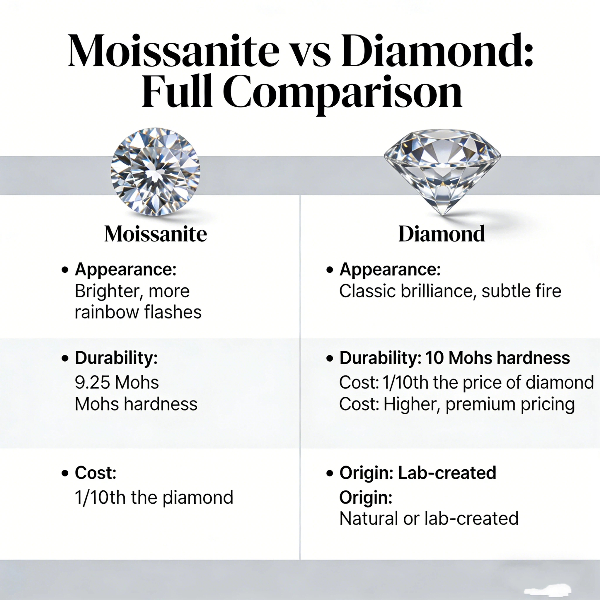
Diamond is a natural gemstone made of pure carbon, formed deep inside the earth over billions of years. It is the hardest natural material in the world and has been a symbol of luxury for centuries. Diamonds are graded by cut, color, clarity, and carat weight, known as the 4 Cs.
Natural diamonds are rare and valuable, making them a traditional choice for engagement rings and high-end jewelry. Learning the basic properties of each stone is the first step in Moissanite vs Diamond: Full Comparison.
What Is Moissanite?
Moissanite is a lab-created gemstone designed to look similar to a diamond. It has excellent brilliance and fire, often appearing brighter than a diamond. It is durable, affordable, and ethically made in controlled environments.
Most people choose moissanite for its low price and stunning visual effect. It is a popular diamond alternative for modern jewelry buyers. These basic details are important in your understanding of Moissanite vs Diamond: Full Comparison.
Price Comparison
Price is the biggest difference between moissanite and diamond. Moissanite costs a small fraction of the price of a diamond of the same size. A high-quality moissanite can cost 90% less than a comparable natural diamond.
Diamonds are expensive because of their rarity, mining costs, and market demand. Moissanite offers a similar look at a budget-friendly price. This is one of the most important parts of Moissanite vs Diamond: Full Comparison.
Durability and Hardness
Both moissanite and diamond are extremely durable and suitable for daily wear. Diamond is the hardest known material, while moissanite is also very tough and resistant to scratches.
Neither stone chips or breaks easily, making both great for rings and daily jewelry. Durability is an important factor when reviewing Moissanite vs Diamond: Full Comparison.
Brilliance and Sparkle
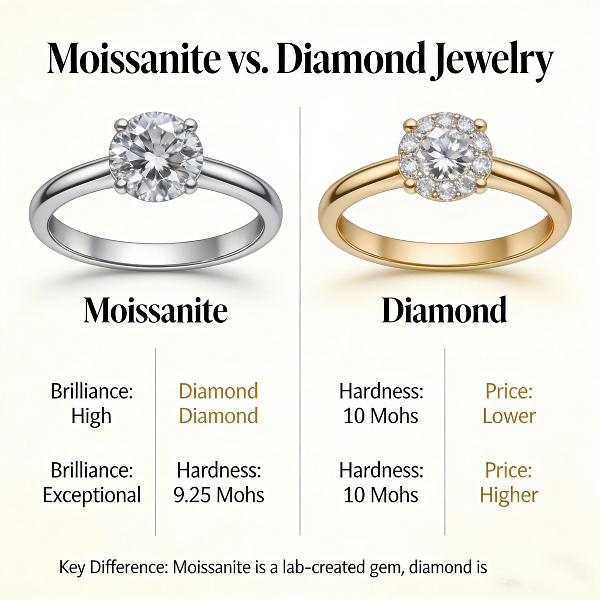
Moissanite has more fire and brilliance than a diamond, meaning it reflects more light and colors. Diamonds have a more subtle, classic sparkle that many people prefer.
Moissanite can sometimes look more colorful and flashy, while diamond has a softer, elegant shine. The difference in sparkle is very noticeable in light. This visual difference is key in Moissanite vs Diamond: Full Comparison.
Value and Resale
Natural diamonds hold resale value and are considered long-term investments. Moissanite has almost no resale value, as it is a lab-created stone.
If you want a gemstone that holds value over time, diamond is the better choice. If you prefer beauty and affordability over investment value, moissanite is a great option. This is an important point in Moissanite vs Diamond: Full Comparison.
Best Uses for Each Stone
Diamond is the traditional choice for engagement rings, wedding bands, and luxury fine jewelry. It is ideal for people who want rarity, value, and a classic look.
Moissanite is perfect for budget-friendly engagement rings, everyday jewelry, and fashion pieces. It works well for people who want maximum sparkle without high cost. Your intended use will help you finalize Moissanite vs Diamond: Full Comparison.
Final Thoughts on Moissanite vs Diamond: Full Comparison
Moissanite and diamond both have unique advantages. Diamond offers rarity, value, and timeless elegance, while moissanite offers incredible sparkle and affordability. The right choice depends on your budget, style, and personal preferences.
By comparing price, durability, sparkle, value, and use, you can easily decide which gemstone suits you best. Both stones are beautiful and durable, making them excellent choices for modern jewelry. You now have all the details you need for Moissanite vs Diamond: Full Comparison.
Further reading:Why is Harry Winston jewelry so expensive
- How much is Graff Diamonds worth? Honest Value Breakdown - Post Date: 2026-04-04
- Why are diamonds so expensive De Beers? Honest 2026 Market Impact Guide - Post Date: 2026-04-01
- Does De Beers sell jewelry? Honest & Definitive 2026 Retail & Product Guide - Post Date: 2026-04-01
- Is De Beers a luxury brand? Ultimate Luxury Brand Analysis 2026 - Post Date: 2026-04-01
- Is Bvlgari Jewelry Worth It? Honest Review on Value & Quality - Post Date: 2026-03-29
- How Much Is Bvlgari High Jewelry? Complete Price Guide & Breakdown - Post Date: 2026-03-29
- How To Clean Diamond Jewelry - Post Date: 2026-03-19
- Why is Cartier so expensive?What is special about Cartier? - Post Date: 2026-03-15
- skyworth tv is what brand?skyworth tv is it easy to use for? - Post Date: 2026-03-11
- Why is Van Cleef so expensive?Is Cartier or Van Cleef cheaper? - Post Date: 2026-03-17
- Why is Graff so expensive?Is Graff a high-end jewelry brand? - Post Date: 2026-03-18
- Is Cartier worth the money?Which is more expensive cartier or bvlgari jewelry? - Post Date: 2026-03-17
- 925 Silver vs Stainless Steel Jewelry - Post Date: 2026-03-20
- Is Bulgari a Luxury Brand?Is Bulgari higher than Cartier? - Post Date: 2026-03-18
- Why is Tiffany so expensive now?Is Tiffany considered a luxury brand? - Post Date: 2026-03-17
- Dreame brand is from which country?Is Dreame owned by Xiaomi? - Post Date: 2026-03-15
- How does the Pigeon brand ensure product safety - Post Date: 2026-03-17
- Fred Force 10 Bracelet Guide: Sizing, Price & Vintage Options - Post Date: 2026-04-05
- Is David Morris a luxury brand? Timeless Craftsmanship That Defines Elite Luxury - Post Date: 2026-04-04
- Who is the designer of Belperron jewelry? The Visionary Who Redefined Luxury - Post Date: 2026-04-04
- What makes Belperron jewelry unique? Fascinating Design Secrets Collectors Adore - Post Date: 2026-04-04
- Is Fred Jewelry under LVMH? Clear Ownership & Brand History Guide - Post Date: 2026-04-04
- Why is Boucheron so Expensive? Craftsmanship & Series That Justify the Price - Post Date: 2026-04-04
- Is Boucheron or Mellerio Older? Fascinating Age Comparison of Iconic Brands - Post Date: 2026-04-04
- When was Boucheron Founded? Fascinating Historical Origins Revealed - Post Date: 2026-04-04
- Is Boucheron a Luxury Brand? Expert Verdict & Analysis - Post Date: 2026-04-04
- Is Damiani a Luxury Brand? A Complete Expert Analysis - Post Date: 2026-04-04